
East and northeast India recorded 29 per cent rain deficit -- 141.5 mm against the normal of 199.9 mm -- from March 1 to May 3.

A record 119.3 mm rainfall pounded Delhi under the impact of cyclonic storm Tauktae and a western disturbance in 24 hours ending 8:30 am on Thursday, breaking all the previous records for May, the IMD said on Thursday.

The city also recorded a maximum temperature of 23.8 degrees Celsius, 16 notches below normal and the lowest in the month of May since 1951, the IMD said.

The IMD defines a normal monsoon as one which delivers between 96 and 104 per cent of the 50-year average rainfall for the season.

The India Meteorological Department (IMD) predicted that cold wave to severe cold wave conditions are very likely to continue in northwest India over the next three days and abate thereafter.

Less-than-expected rainfall and a poor spatial distribution, experts say, can rekindle fears of a rise in food and fuel inflation that can have an impact on the RBI's monetary policy. The fear of less than optimal rainfall due to El Nino this year, analysts believe, is the biggest short-term risk for the markets, which they said has not been fully priced in yet by them. Monsoon set over Kerala on June 08, a week later than its scheduled date.

After a steady surge, prices of pulses, except those of urad and masoor to some extent, are showing signs of stabilising amid a revival of monsoon rains over major growing areas of Maharashtra and Karnataka, and on expectations of a rise in imports. Chana prices, which too had moved up in recent months, have dropped by almost 3 per cent since the end of August due to increased liquidation of government stocks, official data shows. Monsoon rains seem to have benefitted the standing soybean crop as well.

The finance ministry on Thursday raised concerns over the possible impact of El Nio conditions on India this year, saying if recent forecasts came true, the country could see lower agricultural output and higher inflation. "Some meteorological agencies predict the return of El Nio conditions in India this year. "If these predictions are accurate, then monsoon rains could be deficient, leading to lower agricultural output and higher prices," the ministry said in its monthly economic review.
The minimum temperatures are very likely to fall by 2-5 degrees Celsius over most parts of East India, Central India over the next two-three days, while the spell of intense cold can extend beyond that in the Northwest part of the country.
Several global models are predicting El Nio to appear around the second half of the year, which are the crucial rain-bearing months.

The mean minimum temperature for November was 9.6 degree Celsius in 1938; nine degree Celsius in 1931 and 8.9 degree Celsius in 1930, according to IMD data. Normally, the mean minimum temperature for the month of November is 12.9 degree Celsius.

Prime Minister Modi last week called for optimal grain storage, fire audits and mock drills in hospitals as preparations for the harsh summer forecast by the meteorological department.

Delhi recorded the lowest minimum temperature in a decade for the month of December as mercury dipped to a chilling 2.4 degrees on Monday morning.

The upper reaches of Kashmir valley witnessed the first snowfall of the season. The weather department has predicted bad weather for a few days. Snowfall at hill stations like Gulmarg and Pahalgam also brings the hope of revival of tourism in the area which has been severely hit for most of the year due to the coronavirus pandemic.

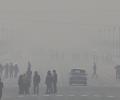
Heavy fog engulfed parts of Delhi with the minimum temperature settling at a notch below normal.

Dense to very dense fog engulfed the Indo-Gangetic plains, including Delhi, for the second morning on the trot on Tuesday, lowering visibility to 50 metres in the city and affecting road traffic and train movement.

Official sources said on Saturday the chill claimed six lives in Barabanki, four in Sultanpur and one in Etah.

Mumbai, its satellite cities, north and central Maharashtra and south Gujarat received rains on Wednesday owing to a low-pressure area in the Arabian Sea and a western disturbance, the India meteorological department said.

Most parts in north India on Sunday continued to reel under cold wave conditions coupled with fog, with mercury plunging below the freezing point in Rajasthan's sole hill station Mount Abu.

Cyclone 'Biparjoy', the first storm brewing in the Arabian Sea this year, has rapidly intensified into a severe cyclonic storm, with meteorologists predicting a 'mild' monsoon onset over Kerala and 'weak' progress beyond southern peninsular under its influence.
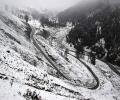
The weatherman has forecast widespread downpour in the Valley on Saturday and scattered precipitation on Sunday.

'Southwest Monsoon has advanced into remaining parts of Rajasthan, Haryana and Punjab and thus it has covered the entire country today, the 26th June 2020,' the IMD said in its special Daily Weather Report.

Three persons died due to severe cold in north India where icy winds swept through most parts and mercury plummeted by several notches.

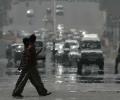
Heavy rains kept the temperature below normal levels on Saturday even as waterlogging in several areas slowed vehicular movement inconveniencing commuters in the national capital.
The cold conditions on Wednesday tightened its grip in Punjab and Haryana with minimum temperature dropping to five degrees Celsius below normal, even as most parts of the region were engulfed with fog and mist disrupting normal life.
All primary schools will remain closed till Wednesday.

The change in weather normally brings cheers to the faces of the people associated with tourism but they have their fingers crossed in view of the prevailing situation in the valley in the wake of abrogation of Article 370.

'After the 4th of May we can expect thunderstorms, dust storms and some rain over a large area of north India.'
Icy cold winds continued to hit Delhi Wednesday bringing the mercury down to below normal levels in the city and its adjoining areas, which were covered by a thin layer of smog.
"The minimum was recorded at 3.7 degree Celsius, which is the lowest this season. The low was three degrees below normal," a Met Department official said. The minimum temperature dropped by over 4 degrees from Monday's low of 8.2 degree Celsius.

The southwest monsoon season concluded on Saturday with India receiving 'below-average' cumulative rainfall -- 820 mm compared to the long-period average of 868.6 mm -- in an El Nino year.
With temperatures dipping below normal and snowfall witnessed in the upper reaches of Himachal Pradesh and the Kashmir Valley, normal life was thrown out of gear for the third consecutive day and over 100 deaths were reported in Uttar Pradesh. The states of Punjab, Haryana and Uttar Pradesh have been the worst affected by the intense cold conditions. A dense fog continues to prevail in UP and the maximum temperature was recorded at 2 to 10 degrees Celsius below normal.

Delhi is likely to record its second-coldest December since 1901 as temperatures are predicted to drop further.

Intense cold wave coupled with dense fog led to the death of 12 persons -- nine in Uttar Pradesh and three in Punjab.

Northern India experienced a slide in temperatures across the region even as the country's south welcomed the south-west monsoon which set in over Kerala and Lakshwadeep on Saturday.

The minimum temperature plunged to 4.2 degrees Celsius in New Delhi on Monday, the coldest December 22 in the last five years and also the lowest this season, even as a thick blanket of fog disrupted normal life in the city and hit flight and train operations.
After several days of clear skies, Delhi was on Tuesday enveloped in a thick blanket of fog as it woke up to a chilly morning with the temperature hovering below normal levels.

North India continued to be under the grip of cold wave as temperatures remained below the normal levels in most parts of the region, while seven persons were killed in avalanches in Himachal Pradesh.

Monsoon in August was almost 24 per cent below normal, which was the sixth driest August since 1901. It came on the back of a 7-per cent monsoon shortfall in July.
Fog engulfs Delhi; min temp around 5° C
